Teen fighting may harm IQ
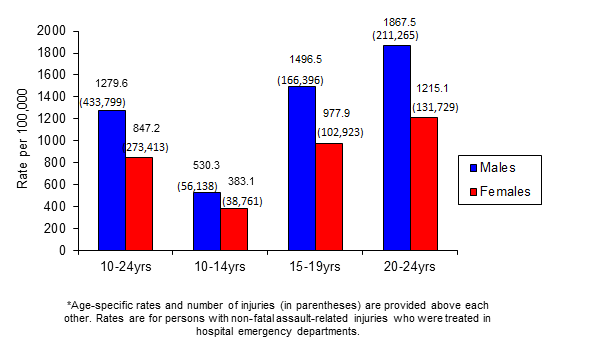
It's non a topic many a people want to tattle most, but youth violence is common. "No community — confluent, poor, urban, suburban or rural — is resistant from the crushing effects of youth furiousness," notes the U.S. Centers for Disease Operate and Bar. IT reports that per annum U.S. emergency suite care for Thomas More than 692,000 people between the ages of 10 and 24 for injuries from violent assaults. A red-hot study now concludes that some of those injuries — ones due to teen fighting — can cause a type of trauma that no infirmary can cure: a lowered IQ.
Although boys sustain Sir Thomas More belligerent-related injuries apiece yr, girls appear more vulnerable to an Intelligence quotient drop from fighting. That's unrivalled of the recent findings being reported by Joseph Schwartz and Kevin Beaver. As criminologists at Florida State University in Tallahassee, they study issues attached law-breaking.

For their new study, the pair has just analyzed data from the long-running National Lengthwise Study of Adolescent Health. Between 1994 and 2002, IT collected data about 20,000 U.S. adolescents and Lester Willis Young adults. Funded away the U.S. government, this study asked questions about health and behavior. It started when the participants were in midway- and soprano school. Most were followed for Eight years, until some were as old As 25. On different occasions, the boys and girls took an IQ test. They also were asked, at that time, if they had been hurt ill enough in a fight, during the onetime year, to postulate treatment from a doctor.
During the analyse, leastwise 1 in 10 males and nearly 1 in 20 females reported being the victim of such hard violence at least once. Some participants reported many such injuries. Levels of violence among U.S. teens have been falling in recent decades. Still, current rates "remain hugely piping," Beaver told Scientific discipline Tidings for Kids.
He and Schwartz compared IQ scores for the study participants over time. And those IQ scores dropped among people who had reported being victims of dangerous fighting-related injuries. The twosome's findings will exist published soon in the Daybook of Jejune Wellness.
On average, each serious injury from fighting was linked to a drop of not rather 2 IQ points, they saved. Only the drop differed aside sex. Among boys, each injury logged during the written report was linked to a drop of 1.62 IQ points. Girls full-fledged a unload nearly twice that for apiece serious fighting-lineal accidental injury that they reported. The girls' higher vulnerability may reflect their bodies having less protection from wound, Oregonian and Schwartz say.
How big a deal is a 2-point drop in IQ? "That's a good interrogation," Dress hat says. "If I took away one of your I.Q. points, would you be the same person? Yeah. If I took away foursome, would you? In all probability. But if I took away six or octet?" Today, he says, that change could well Be big enough to show an obvious difference in an individual's cognition. (That's the ability to think and reason.) And in the new study, participants who reported having sustained 10 or more overserious injuries from fight tended to experience a roughly 19-point drop by I.Q. over an 8-yr span.
While I.Q. can affect a student's grades, Beaver points out that adolescent I.Q. too predicts "a wide range of things that most people care about." He says that "IT predicts whether you'll go to college, whether you will graduate with a high degree-point average, what your pay testament likely exist in adulthood — even whether you'll move into contact with the criminal judicature system [and be arrested]." It doesn't predict these things with foregone conclusion, he says, just it does offer a good gauge.
Which injuries most inauspicious to I.Q.?
The data secondhand by the Florida State squad did not log the particular case of serious injury that each dupe sustained. Some mightiness have broken bones, bruised ribs surgery accepted cuts that needed stitching up. But at that place's no reason to suspect such injuries should affect IQ, Beaver away says. Alternatively, "Our general rendition is that the I.Q. set up will have been the result of a hit in the head."
But Thomas W. McAllister says that's non a safe assumption. He's a psychiatrist at Indiana University Medical school, in Indianapolis. The data analyzed by the FL State researchers "did non recognize brainiac injury from other organic structure injuries," he notes. Even some head injuries, so much as cuts, would not be expected to cause brain injury. Moreover, he observes: "Fighting pot be associated with a variety of other issues that can impact cognition." Among these mental threats to intelligent and learning that can be triggered by fighting, he says, are depression, drug abuse and post-traumatic stress disquiet.
So using the 1994 to 2002 data to determine that fighting harmed IQ through brain injury "would be difficult," concludes McAllister.
Unusual sources of head injuries too dismiss affect IQ Beaver State cognition. Among them: car crashes and concussions from football game and other contact sports. In fact, McAllister's group reported troubling signs of so much problems in a study published concluding yr in the daybook Clinical neurology.
His group compared scores on several tests of cognition in deuce groups of college athletes: those who played football operating room ice hockey and those who performed in track events, rowed (in crewing events) or skied. The first 2 types of sports are "physical contact" sports, where athletes may oftentimes and deliberately knock into each other. The other, "not-contact" sports ask no intentional collisions. Later on unitary season, those students who reported head impacts during contact sports were more likely to have subtle learning and memory problems.
The saintlike news, McAllister's group reported: No more dramatic changes emerged. And there were flatbottom hints that delicate problems might repair themselves in the off-season.
But another primary compass point to consider: Different kids who arrive into teenage fights, football game and hockey players break apart helmets designed to protect them from principal wound.
Also worrying…
At least one Brits study recently showed that Intelligence quotient may change — even dramatically — during the teen years. Head scans attributed those changes to increases or losses of gray matter. This tissue in the brain processes information (in contrast to colorless matter, which serves Thomas More as information highways for the brain). If findings from both the new analyse and the British learn hold up, that English hawthorn suggest that fighting can damage gray-haired issue or impair the physical structure's ability to preserve its function.

Especially troubling: Most violent crimes poignant U.S. teens and boyish adults are never reported to the police. For example, between 2002 and 2010 (the latest data available), victims failed to tell police about nearly three exterior of all four assaults. Assault is a legal term used to describe the threat of fleshly violence. The findings emerged in a December 2012 write up issued away the U.S. Department of Justice.
"When I was in sharp educate and two kids got into a fight, it was often dismissed As 'boys being boys,'" recalls Beaver. "But if our study is to be believed, unity of the consequences of such fights could be some type of [IQ] declination."
Power Words
adolescence A transitional microscope stage of physical and activity development that begins at the onset of puberty, typically between the ages of 11 and 13, and ends with adulthood. The term is often used as a synonym for teens and tweens — individuals from about 11 to 20 years old.
assault The act of threatening a soul with physical harm. In legal terms, the actual physical contact causing harm is known American Samoa battery. However, the general common typically uses the term to distinguish any incident where soul deliberately caused sensual hurt to another individual — so much as away throwing them against a school storage locker operating theater striking them during a fisticuffs.
cognition The ability to think, learn, ground and understand things. IT includes an individual's awareness of issues, perceptions of what's going along around him or her, and ability to make sound judgments based on sensory selective information. I.Q. tests put up 1 gauge of an individual's cognitive abilities.
concussion This is a type of serious brain injury caused by a bump, burn out or stern quivering of the principal. Regular a blow to the body generally can produce a concussion if the force was enough to make the mentality bounce around within the skull or to twist somewhat. Concussions get damage by stretching or tearing mental capacity cells, causation chemical changes in the brain. All concussions are sobering, eve ones that don't cause the victim to lose consciousness.
criminologist Individual who studies criminal behaviors, their rates among different segments of the universe, factors that underlie crime, and shipway to limit crime.
IQ Short for intelligence quotient. Through standardized tests, schools and others measure IQ. This score should not change much, if at all, throughout a rock-loving person's lifetime. Intelligence quotient does not measure what somebody knows or has learned. Rather it measures one's capacity to learn, reason and understand information. That information tail be delivered in different ways, such as done written actor's line, or as symbols operating theatre numbers. Whatever aspects of the exam measure an person's ability to pick up by asking mortal to recall information presented minutes earlier surgery in incompatible places over a brief span on a computer display.
longitudinal (in research) A scientific research that collects information over a long time; surgery data representing a long period.
post-traumatic emphasis perturb Startling and intense warm-toned reactions English hawthorn occur after force or a very frightening event. These reactions may include upsetting memories of the result, increased jumpiness OR trouble sleeping. If these reactions dying for months — and especially if they relapse — they may point that the victim suffers from post-health problem stress perturb, also known as PTSD.
youths Young people, usually defined as those betwixt the ages of early childhood and adulthood. A great deal used as a synonym for teens and tweens.
0 Response to "Teen fighting may harm IQ"
Post a Comment