How Do You Know if a Reaction Is Stereospecific
8 Stereoselective reactions
- Stereochemical aspects of organic synthesis
- Stereospecific reactions
- Stereoselective reactions
- The mechanistic basis of stereoselectivity
- Addition of Xtwo to alkenes
- Generating stereogenic centres with achiral substrates
- Nucleophilic addition to prochiral carbonyl groups
- Hydroboration of alkenes
- Generating stereogenic centres with chiral substrates
- Nucleophilic add-on to a homochiral circadian ketone
- Nucleophilic addition to a racemic cyclic ketone
- Enantioselective hydride reduction of carbonyl compounds
8.1 Stereochemical aspects of organic synthesis
We accept studied enantiomers and diastereoisomers, their properties, methods of detection, separation etc. In this section we look at stereochemistry in the context of synthesis. To start with, some important definitions:
8.one.1 Stereospecific reactions
A stereospecific reaction is one which, when carried out with stereoisomeric starting materials, gives a product from ane reactant that is a stereoisomer of the product from the other. 'Stereospecific' relates to the mechanism of a reaction, the best-known example being the Due southNorth2 reaction, which always gain with inversion of stereochemistry at the reacting centre.
Examples:

8.1.ii Stereoselective reactions
A stereoselective procedure is one in which i stereoisomer predominates over another when two or more than may be formed. If the products are enantiomers, the reaction is enantioselective ; if they are diastereoisomers, the reaction is diastereoselective . Stereoselectivity is dominated past the structural features of the reactants.
Case:
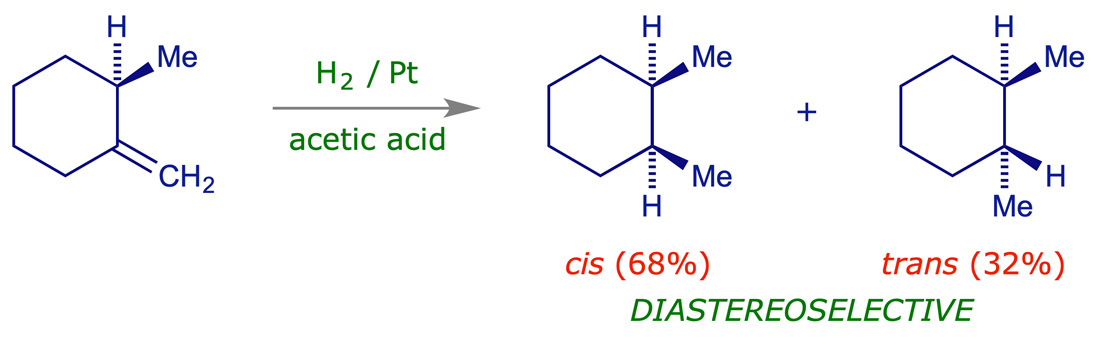
The reaction in a higher place is stereospecific (only syn improver) only the stereoselectivity is depression (ca. 2:ane). To sympathise such a reaction we must analyse it mechanistically . We will then also come across that optically agile products cannot be created using achiral (or racemic) starting materials in an achiral solvent. The product in such a instance must also exist achiral (or racemic).

8.2 The mechanistic basis of stereoselectivity
In this brief assay nosotros can only scratch the surface of organic synthesis and look at just a few illustrative examples of selectivity. To be of synthetic use, a reaction must be reliable, anticipated and selective – features which must be analysed from a mechanistic viewpoint.
The chemistry of alkenes, alkanols and carbonyl compounds provides the core of organic synthesis. Improver reactions of double bonds (C=C or C=O) can easily provide us with new stereogenic centres, and we need to know how to exploit them.
viii.2.one Addition of 102 to alkenes
There is no regiochemical issue in the addition of a halogen (Brii, Cl2 etc.) to an alkene because the East and Nu are the same, only the question of stereoselection remains mechanistically significant. In the addition of HX to an alkene we saw that the addition of the electrophile (H+) leads to the build-up of positive accuse on the adjacent carbon, somewhen giving rising to a planar carbocation. Subsequent reaction with a nucleophile can in principle take place on either face of this cation, which produces a mixture of syn- and anti-addition products. In contrast, the bromination of elementary alkenes is stereospecific; information technology is anti-selective due to the intermediate germination of a cyclic bromonium ion.

The overall process is anti-addition of Br2 to the double bond because the cyclic bromonium ion undergoes ring-opening in an SouthwardNtwo process (i.east. strictly past inversion) in which the Br− counterion serves every bit the nucleophile. This SN2 footstep takes places at the about electropositive carbon of the cyclic ion (i.eastward. the location of the original positive charge).
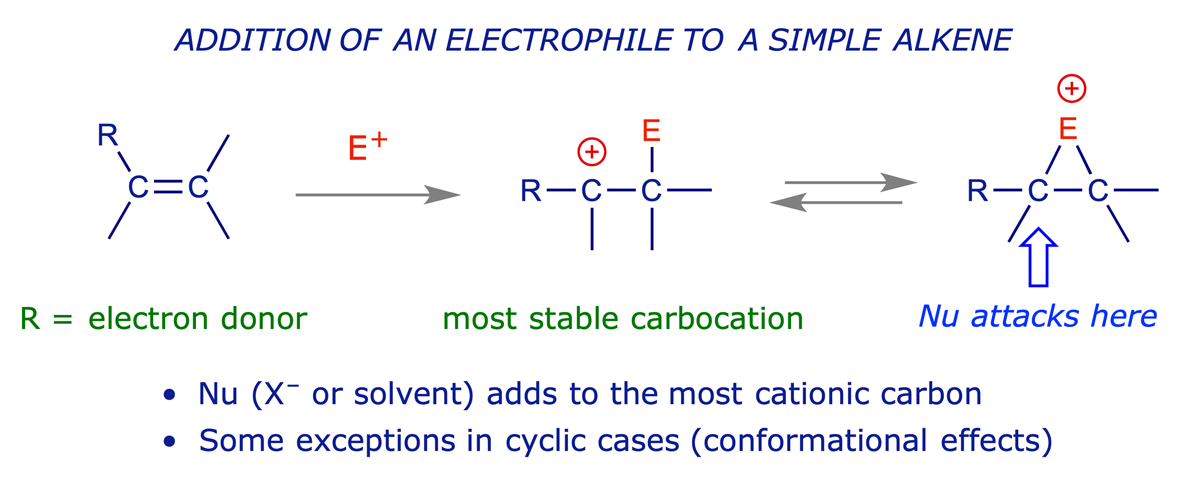
The attacking nucleophile tin also be the solvent, and the resulting combination of versatility and stereospecificity makes the reaction very useful in synthesis. Chloronium ions accept also been observed but they are much more reactive as electrophiles (for case, they react with benzene). The tendency for bridging is F < Cl < Br < I.
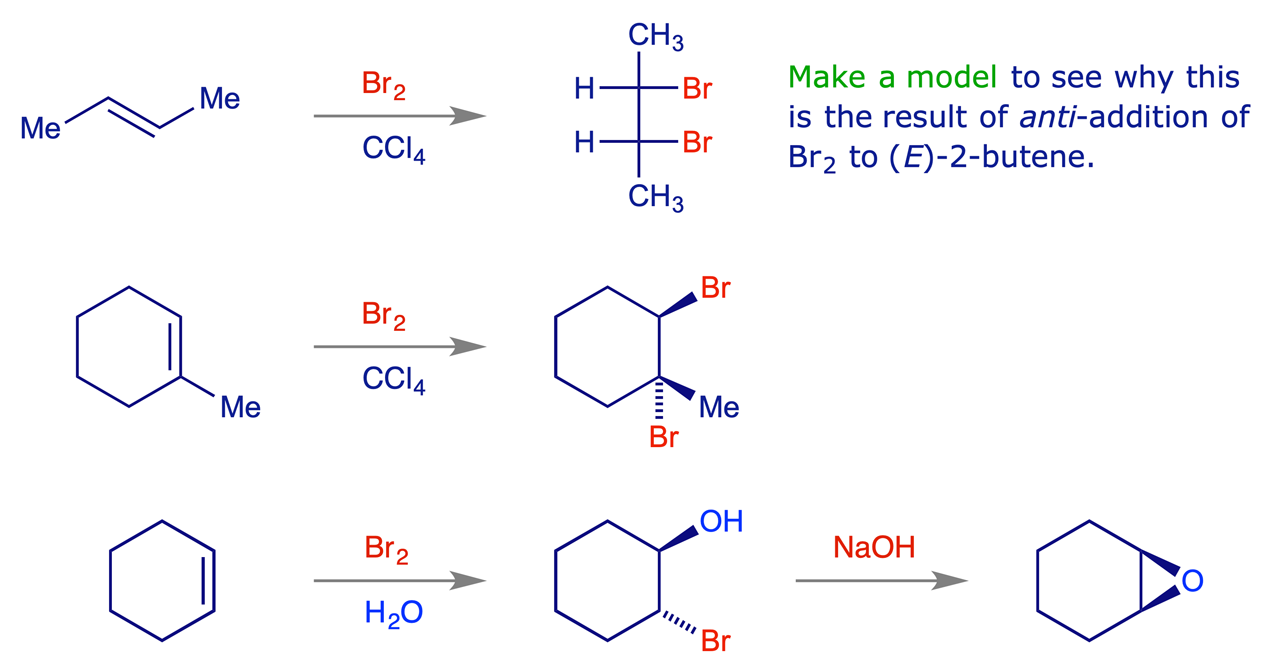
When the cationic centre is strongly stabilised by a structural feature, due east.chiliad. an aromatic ring (resonance-stabilised cation), the not-selective mechanism via a free carbocation competes with the bridged ion pathway, and some syn-production is too formed.
Example:

8.3 Generating stereogenic centres with achiral substrates
We take just seen a reaction in which stereogenic centres are generated from planar carbon. Carbonyl (C=O) and alkene (C=C) bonds are prochiral and their chemistry provides many examples which illustrate the principles of stereoselectivity in synthesis.
8.3.1 Nucleophilic addition to prochiral carbonyl groups
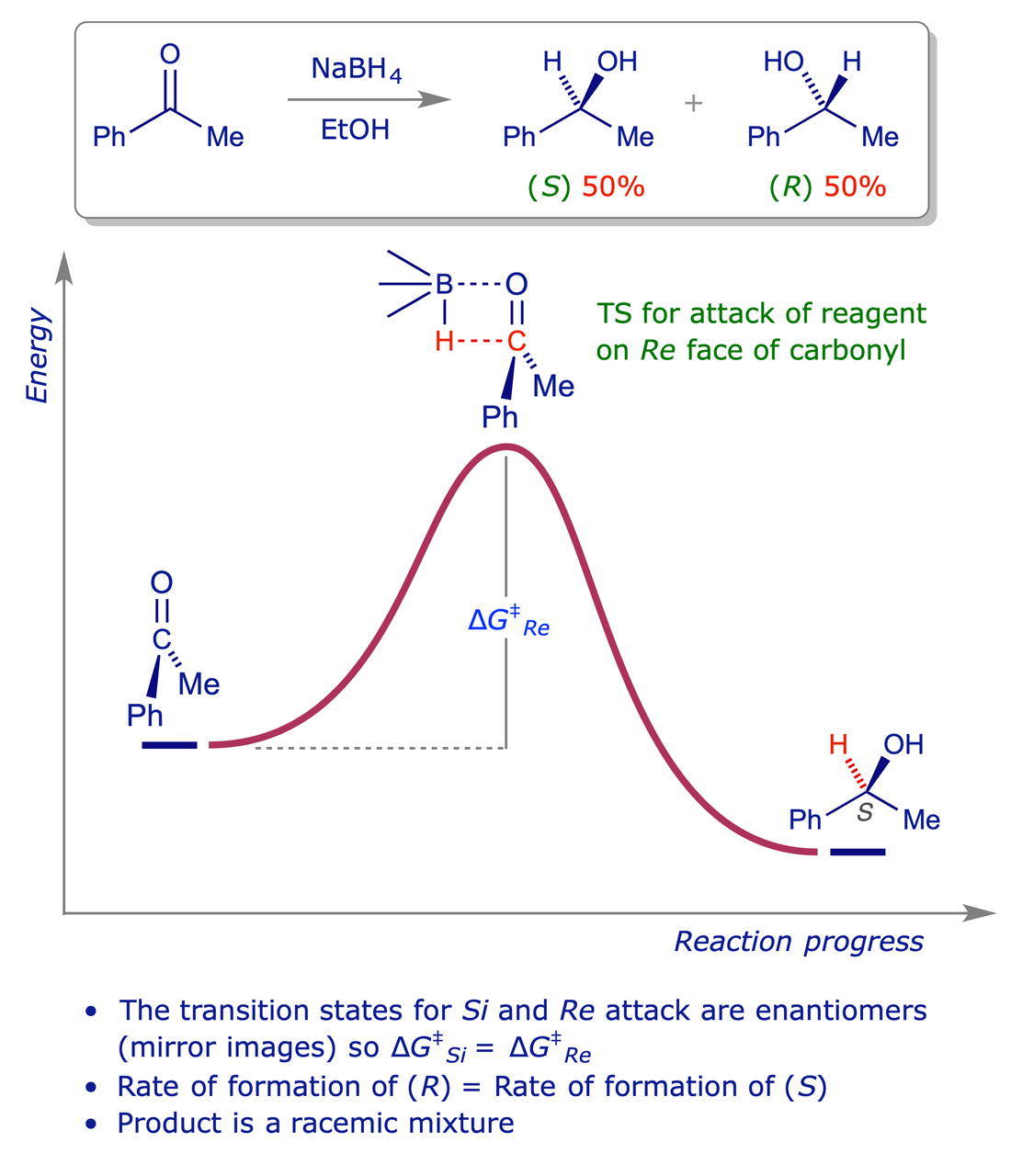
The reduction of acetophenone, which is achiral, with sodium borohydride gives ane-phenylethanol, which contains a stereogenic centre. However the product is racemic, and we must analyse the mechanism to understand why this should be the case. Ii transition states are possible for bonding betwixt the achiral BH4 − and the achiral (planar) ketone, one leading to the (S)-booze and the other to the (R)-alcohol. Only the two transition states are enantiomeric, and must therefore have identical physical properties. The activation barrier (ΔThousand ‡) leading to each of them is the same, so they course at exactly the same rate (cf. the Arrhenius equation).
8.3.ii Hydroboration of alkenes
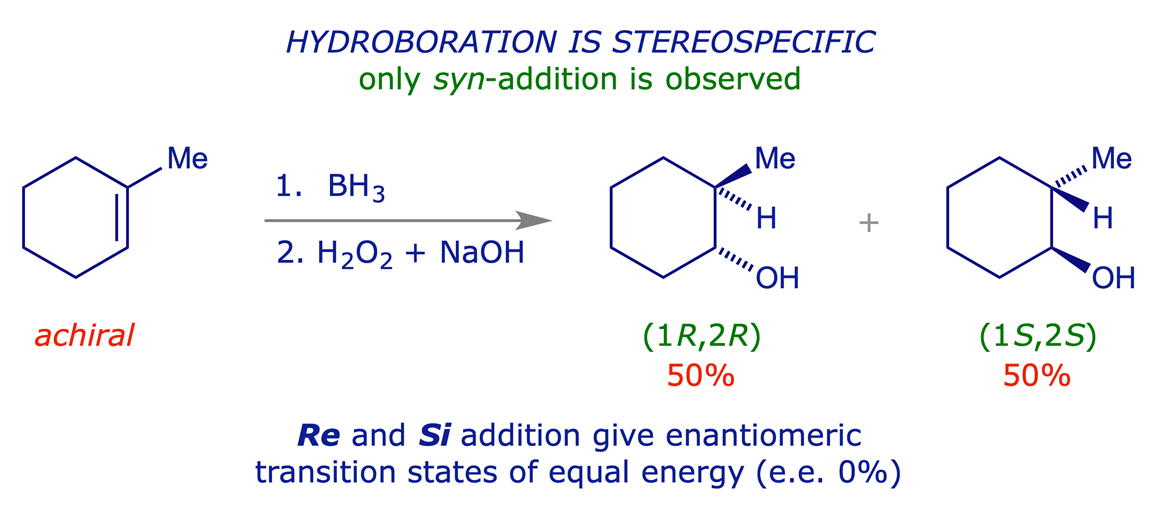
Hydroboration is an important synthetic process. Borane is electron-deficient and readily reacts with π-bonds (which are electron-rich). The add-on is regioselective – the boron atom adds to the least substituted terminate of the double bond. The addition is stereospecific , with the B and H atoms always adding to the same face of the double bond ( syn-add-on ).

The full mechanism of hydroboration is shown in Appendix B (PDF, opens in new window). The first step is the concerted regioselective addition of the alkene π-bail (electron rich) to a B–H bond (electron poor):

With an achiral alkene the improver can proceed with equal facility on the Re and Si faces of the double bail, through enantiomeric transition states, leading to a chiral but racemic production.
viii.four Generating stereogenic centres with chiral substrates
When a starting material already possessing a stereogenic centre undergoes a reaction which leads to the generation of a new ane, diastereoselectivity (and how to control it) becomes a major consideration.
8.4.1 Nucleophilic addition to a homochiral cyclic ketone
Whereas the add-on of a nucleophile to the two faces of acetophenone (Section 8.3.1) leads to a pair of enantiomers, the prior presence of the stereogenic center in 2-methylcyclopentanone means that the two faces of the carbonyl group are diastereotopic (rather than enantiotopic), and hydride addition can lead to two separable products (diastereoisomers) in unequal amounts. In this reaction the arroyo of the hydride reagent to the C=O group is easier from the rear (Si) confront, further away from the big methyl group. Our starting material is enantiomerically pure (iiS)-enantiomer, then each of the two diastereoisomers produced will also be enantiomerically pure.
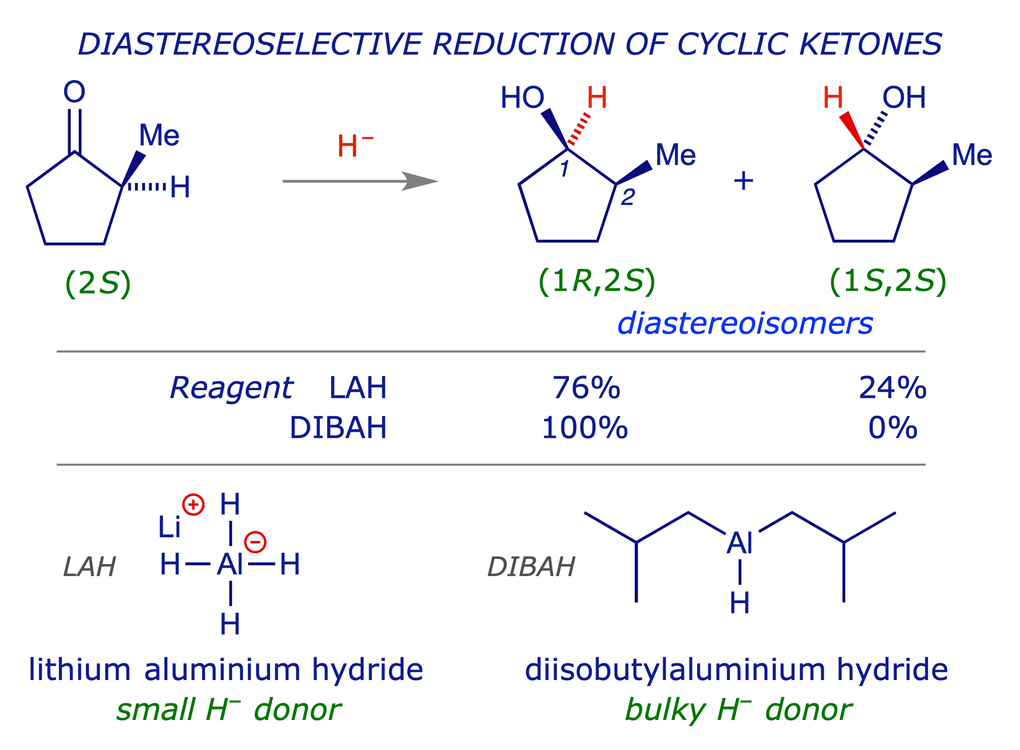
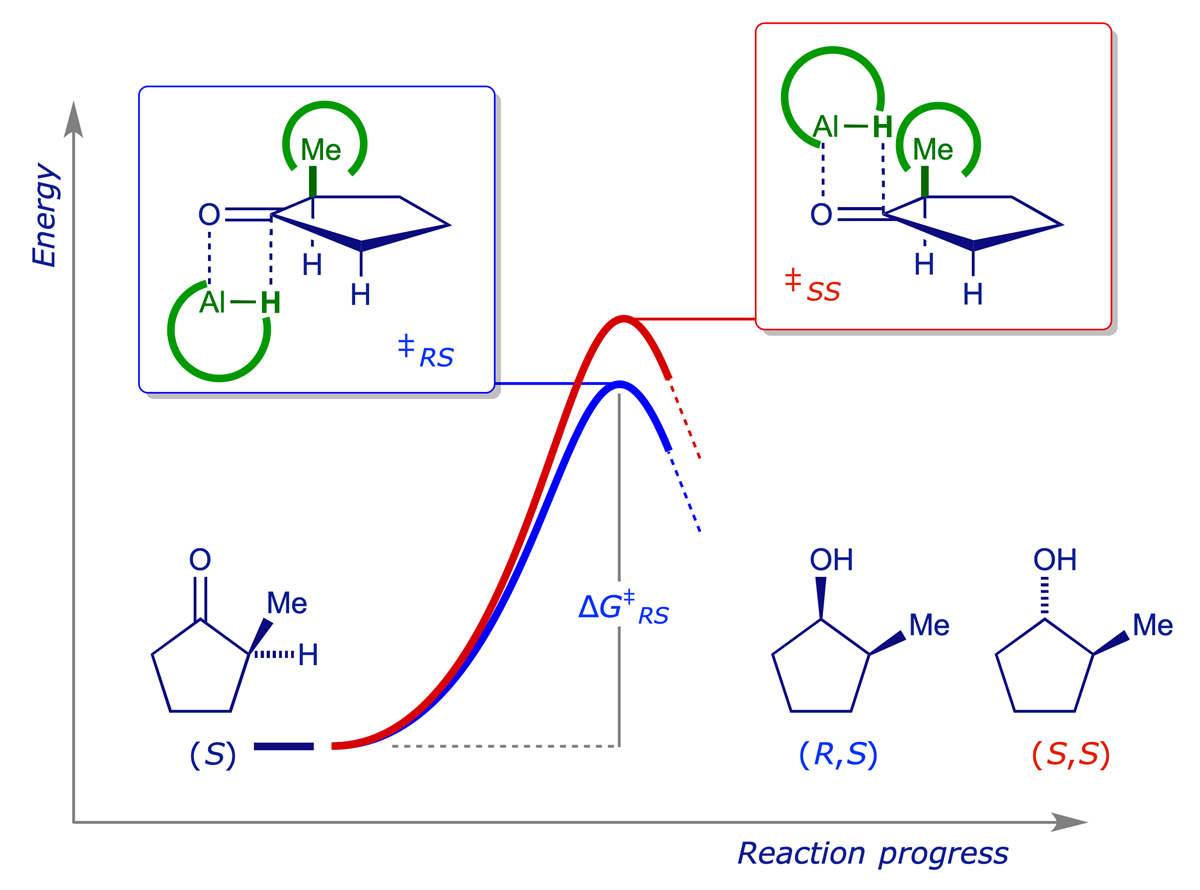
Improver reactions like this are irreversible and so proceed nether kinetic control, the production ratio reflecting the relative rates of the two modes of addition. These are dissimilar considering the 2 transition states are diastereoisomeric and have unequal energies. Steric furnishings in the transition states decide their energies and hence the product ratio. This is a typical case of steric arroyo control, in which a substrate reacts preferentially at the least hindered site. The more bulky the reagent, the bigger the preference for attack from the least hindered face up.
The proximity of the 2-methyl grouping to the prochiral reaction site (C-i) engenders a high level of steric approach control in the above reaction, and the cyclic (inflexible) nature of the ketone ensures that the methyl grouping cannot get away from the bond-forming procedure. More distant stereogenic centres would be expected to exert less influence on reactions at a prochiral sites.
8.4.two Nucleophilic addition to a racemic cyclic ketone
To remind yourself of the fundamental principle that not-racemic products cannot exist created from racemic starting materials in an achiral medium, consider what would happen if the reaction in the previous section was performed on racemic 2-methylcyclopentanone. The outcome is shown below.
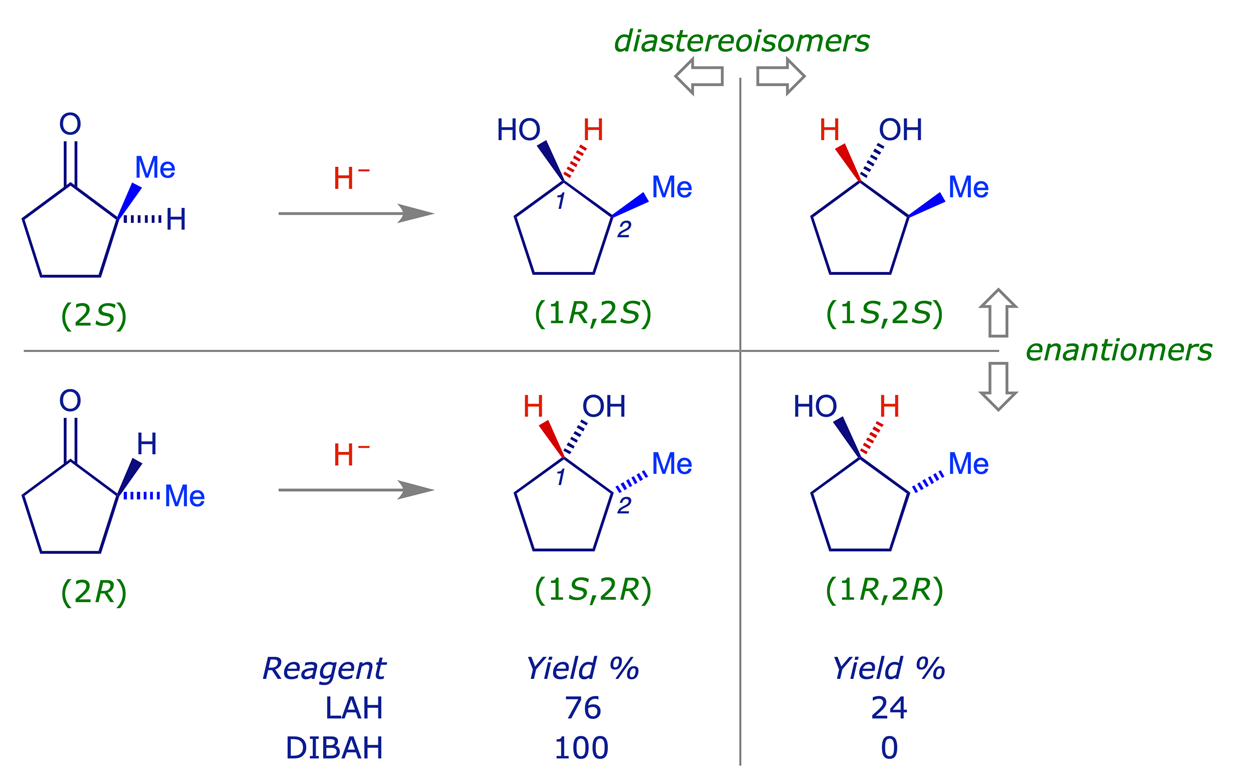
The ratio of diastereoisomers formed in the reaction is 76:24 (i.e. the d.e. is 52%), and this will be the same for both enantiomers of the starting material. And so we can say:
- Racemic ketone gives 76% yield of racemic cis-ii-methylcyclopentanol
- If the east.east. of the starting ketone is 60%, and so each product will each have an due east.e. of 60%
8.four.3 Enantioselective hydride reduction of carbonyl compounds
The reduction of acetophenone with NaBH4 (department 8.2.ane) confirmed that achiral hydride reducing agents cannot react in an enantioselective mode. However, Yamaguchi and Mosher found that the fractional decomposition of lithium aluminium hydride (LiAlHa) with a chiral alcohol gave a modified chiral reducing agent capable of reducing acetophenone enantioselectively. Although the method is simple, it should be noted that the level of enantioselection (e.e. 68%) is not platonic in a applied sense because of the difficulties associated with purifying (i.eastward. resolving) the production in club to obtain a single enantiomer.
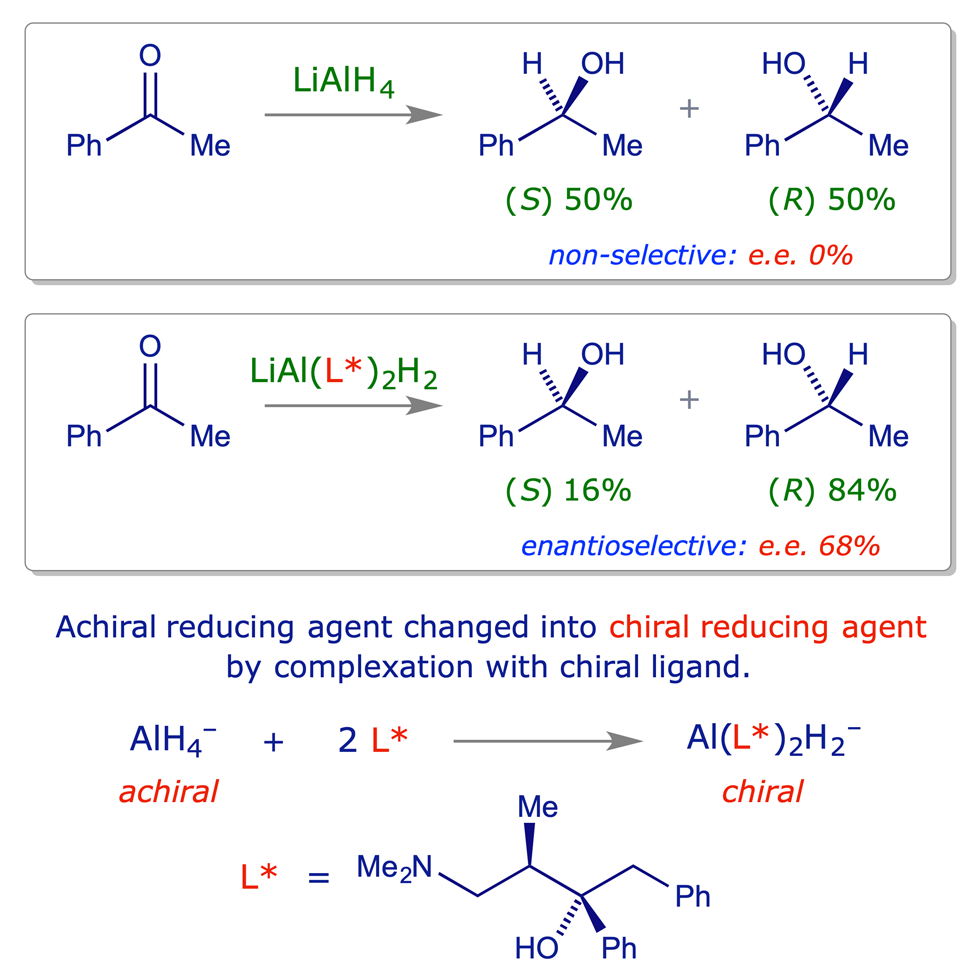
Reference: Southward. Yamaguchi and H. S. Mosher, J. Org. Chem., 1973, 38, 1870–1877 (https://doi.org/10.1021/jo00950a020).
Source: https://www.stereoelectronics.org/webSC/SC_08.html
0 Response to "How Do You Know if a Reaction Is Stereospecific"
Post a Comment