What Is the Average 2019 Grocery Bill for a Family of 2 Adults
Quick Stats
- The average Australian household's weekly grocery spend $254.96
- Couples with children between the ages of 5-14 spend the nearly on weekly grocery shops at $336
- New Due south Wales households spent the most on weekly groceries at $275.41
- Total spend on groceries and non-alcoholic beverages make up xvi.vi% of total goods and services expenditure in Australia
Weekly spend on food by stage of life
The boilerplate grocery bill for the boilerplate Australian varies greatly depending on the stage of life they are in.
One person under 35

Couple only nether 35

Family of four with kids (youngest under 5)
.jpg)
Family of 4 with kids (youngest betwixt five-xiv)
.jpg)
Family of four with kids (youngest 15 or over)
.jpg)
On average couples with children between the ages of 5-fourteen spend the nigh on weekly grocery shops at $336. Singles nether 35 had the cheapest average weekly grocery spend at $122, they also spent the to the lowest degree on alcohol at $22. Couples with children over 15 spent the most on booze each calendar week at $47.
Boilerplate cost of food by land
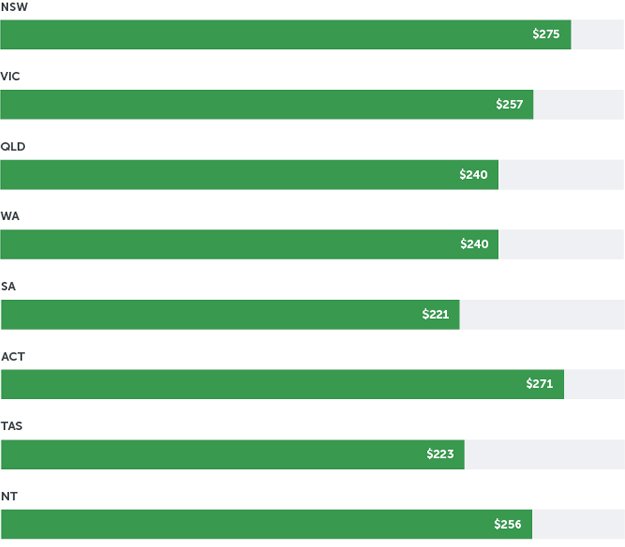
The average household weekly expenditure on food and not-alcoholic drinks varied state by state with a variance of $54.31 between the highest boilerplate weekly spend (New S Wales $275.41) and the everyman (Southward Australia $221.10). On average, nutrient and non-alcoholic drinkable purchases make upwards xvi.6% of the total goods and services expenditure in Australia.
| Food | NSW | VIC | QLD | WA | SA | Act | TAS | NT |
|---|---|---|---|---|---|---|---|---|
| Staff of life | $6.97 | $7.16 | $6.86 | $7.03 | $vi.84 | $7.67 | $7.08 | $4.95 |
| Rice | $1.09 | $1.03 | $0.82 | $0.89 | $0.66 | $i.48 | $0.45 | $1.06 |
| Meat | $26.73 | $27.51 | $27.77 | $28.88 | $25.76 | $30.29 | $24 | $31.01 |
| Eggs | $2.01 | $2.fourteen | $one.88 | $2.33 | $1.lxxx | $2.23 | $one.66 | $1.76 |
| Dairy Products | $14.16 | $xv.65 | $xvi.23 | $15.twenty | $15.19 | $16.29 | $sixteen.25 | $16.63 |
| Fruit | $13.50 | $12.03 | $eleven.eighteen | $12.54 | $x.24 | $14.30 | $9.42 | $11.38 |
| Vegetables | $16.28 | $17.22 | $14.68 | $16.73 | $14.28 | $xviii.96 | $16.04 | $17.01 |
| Condiments | $25.xl | $26.49 | $24.63 | $27.27 | $23.24 | $26.36 | $25.84 | $22.89 |
| Meals out & Fast Nutrient | $110.33 | $93.05 | $eighty.04 | $74.46 | $71.38 | $100.82 | $71.59 | $85.81 |
New South Wales
The average New South Wales household'due south total weekly spend was the most expensive in the country at $275.41. On average households in New South Wales spent less on dairy products than any other state at $14.xvi. However on average they spent the near on meals out and fast food at $110.33 a calendar week. The total corporeality spent on food and non-alcoholic beverages made upward xvi.ane% of the total goods and services expenditure for New South Wales households.
- Bread = $6.97
- Rice = $i.09
- Meat = $26.73
- Eggs = $2.01
- Dairy products = $14.sixteen
- Fruit = $13.fifty
- Vegetables = $16.28
- Condiments = $25.40
- Meals out & fast nutrient = $110.33
Total spend = $275.41
Victoria
The average Victorian household's total weekly spend was merely above the country's average full weekly spend at $257.sixteen. The total amount spent on food and nonalcoholic beverages made up xvi.9% of the total goods and services expenditure for Victorian households.
- Bread = $7.16
- Rice = $1.03
- Meat = $27.51
- Eggs = $ii.14
- Dairy products = $15.65
- Fruit = $12.03
- Vegetables = $17.22
- Condiments = $26.49
- Meals out & fast nutrient = $93.05
Total spend = $257.16
Queensland
The average Queensland household'southward full weekly spend was below the country's average total weekly spend at $239.53. The total corporeality spent on nutrient and nonalcoholic beverages made up 16.iii% of the total goods and services expenditure for Queensland households.
- Bread = $6.86
- Rice = $0.82
- Meat = $27.77
- Eggs = $ane.88
- Dairy products = $16.23
- Fruit = $xi.18
- Vegetables = $14.68
- Condiments = $24.63
- Meals out & fast food = $lxxx.04
Total spend = $239.53
Western Australia
The average Western Australian household's total weekly spend was below the land's average total weekly spend at $239.53. On average households in Western Australian spent the most on eggs than whatsoever other state at $2.33. The full amount spent on food and non-alcoholic beverages fabricated upwards 16.six% of the total goods and services expenditure for Western Australian households.
- Bread = $vii.03
- Rice = $0.89
- Meat = $28.88
- Eggs = $2.33
- Dairy products = $fifteen.20
- Fruit = $12.54
- Vegetables = $16.73
- Condiments = $27.27
- Meals out & fast food = $74.46
Full spend = $239.77
South Australia
The boilerplate South Australian household's total weekly spend was the to the lowest degree expensive in the country at $221.10. On average households in South Australia spent the most on eggs than whatever other country at $2.33. However on average they spent the least on vegetables at $14.28 and meals out and fast nutrient at $71.38 a week. The total corporeality spent on food and non-alcoholic beverages made upward 17.3% of the total appurtenances and services expenditure for South Australian households.
- Bread = $6.84
- Rice = $0.66
- Meat = $25.76
- Eggs = $1.80
- Dairy products = $15.19
- Fruit = $10.24
- Vegetables = $14.28
- Condiments = $23.24
- Meals out & fast food = $71.38
Total spend = $221.ten
ACT
The average Canberra household's total weekly spend was the second highest in the country at $270.89. On average households in Canberra spent more on bread than whatsoever other state at $7.67, rice at $1.48, fruit at $eighteen.09 and vegetables at $18.96 a week. The full corporeality spent on food and not-alcoholic beverages made up 16.1% of the full goods and services expenditure for Canberra households.
- Bread = $7.67
- Rice = $1.48
- Meat = $30.29
- Eggs = $2.23
- Dairy products = $16.29
- Fruit = $14.30
- Vegetables = $18.96
- Condiments = $26.36
- Meals out & fast food = $100.82
Total spend = $270.89
Tasmania
The average Tasmanian household's full weekly spend was the second everyman in the country. On boilerplate households in Tasmania spent less on rice each than any other country at $0.45, meat at $24, eggs at $1.66 and fruit at $12.59 a week. The total amount spent on nutrient and non-alcoholic beverages fabricated upward 17.v% of the total goods and services expenditure for Tasmanian households.
- Breadstuff = $7.08
- Rice = $0.45
- Meat = $24
- Eggs = $1.66
- Dairy products = $xvi.25
- Fruit = $9.42
- Vegetables = $16.04
- Condiments = $25.84
- Meals out & fast food = $71.59
Total spend = $223.01
Northern Territory
The average Northern Territory household'south full weekly spend was just above the land's boilerplate total weekly spend. On average households in the Northern Territory spent less on bread than whatsoever other state at $four.95 a week. However on boilerplate they spent the most on meat at $31.01 and dairy products at $xvi.63 a calendar week. The total amount spent on food and non-alcoholic beverages made upward 15.four% of the total goods and services expenditure for Northern Territory households.
- Bread = $four.95
- Rice = $1.06
- Meat = $31.01
- Eggs = $ane.76
- Dairy products = $16.63
- Fruit = $eleven.38
- Vegetables = $17.01
- Condiments = $22.89
- Meals out & fast food = $85.81
Total spend = $256.28
Australian average
- Staff of life = $7
- Rice = $0.97
- Meat = $27.27
- Eggs = $two.05
- Dairy products = $15.xx
- Fruit = $12.27
- Vegetables = $16.24
- Condiments = $25.57
- Meals out & fast food = $92.08
Total spend = $254.96
Evolution of grocery prices in Australia
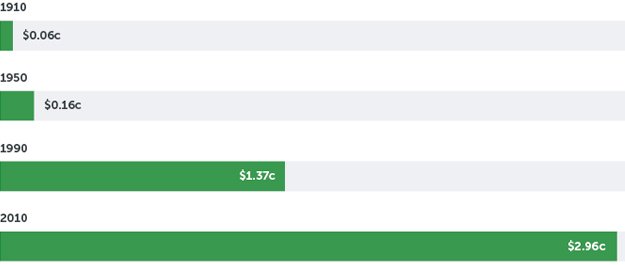
Taking aggrandizement rates into consideration, the price of nutrient over the years has drastically inverse.
| Nutrient | 1910 | 1950 | 1990 | 2010 |
|---|---|---|---|---|
| Milk | $0.44 | $0.88 | $two.33 | $2.27 |
| 1lb of Tea | $0.14 | $0.08 | $1.64 | $viii.50 |
| Bread | $0.06 | $0.16 | $ane.37 | $2.96 |
| Butter | $0.30 | $0.26 | $ii.09 | $2.78 |
| 1kg of Meat | $0.55 | $one.24 | $7.03 | $ten.72 |
1910
- Milk = $0.44 (equivalent of $25.95 today)
- 1lb of Tea = $0.fourteen (equivalent of $3.78)
- Breadstuff = $0.06 (equivalent of $1.62 today)
- Butter = $0.thirty (equivalent of $8.xi today)
- 1kg Meat = $0.55 (equivalent of $33.52 today)
1950
- Milk = $0.88 (equivalent of $20.xx)
- 1lb of Tea = $0.08 (equivalent of $0.81)
- Bread = $0.16 (equivalent of $4.32 today)
- Butter = $0.26 (equivalent of $5.25 today)
- 1kg Meat = $ane.24 (equivalent of $fourteen.55 today)
1990
- Milk = $2.33 (equivalent of $4.30)
- 1lb of Tea = $1.64 (equivalent of $iii.03)
- Breadstuff = $i.37 (equivalent of $2.53 today)
- Butter = $2.09 (equivalent of $3.86 today)
- 1kg Meat = $7.03 (equivalent of $12.98 today)
2010
- Milk = $2.27 (equivalent of $2.51)
- 1lb of Tea = $8.fifty (equivalent of $9.38)
- Bread = $ii.96 (equivalent of $iii.27 today)
- Butter = $ii.78 (equivalent of $3.07 today)
- 1kg Meat = $ten.72 (equivalent of $11.83 today)
Items such every bit meat, butter and milk accept become more affordable over the past century as their availability has increased. The price of tea notwithstanding has only risen over the years while the price of bread has remained fairly consistent.
Toll comparison of staff of life
Data on this website was sourced in June 2019 with the latest available data from December 2018. AGS does not guarantee the accuracy or completeness of the information and accepts no liability whatsoever arising from or connected in any way to the use or reliance upon this data.
Source: https://www.budgetdirect.com.au/home-contents-insurance/research/average-grocery-bill-statistics.html
0 Response to "What Is the Average 2019 Grocery Bill for a Family of 2 Adults"
Post a Comment