What Is Involved in Turning a Breech Baby
Overview
What is a breech baby?
A breech baby, or breech birth, is when your baby'due south feet or buttocks are positioned to come up out of your vagina first. Your infant'due south head is up closest to your chest and its lesser is closest to your vagina. Most babies will naturally move so their head is positioned to come out of the vagina first during nativity. Breech is common in early pregnancy and most babies will move to a head-first position by 36 weeks of pregnancy. This head-first position is called vertex presentation and is the safest position for birth.
How mutual is a breech baby?
There is a small-scale gamble that your baby will not move into a head-first position earlier 37 weeks of pregnancy. Breech babies business relationship for about 3% to 4% of all full-term pregnancies.
What are the types of breech position a baby can be in?
There are several fetal positions your baby may nowadays in. Ideally, your baby is positioned caput-downwardly, facing your back, with their chin tucked to their breast.
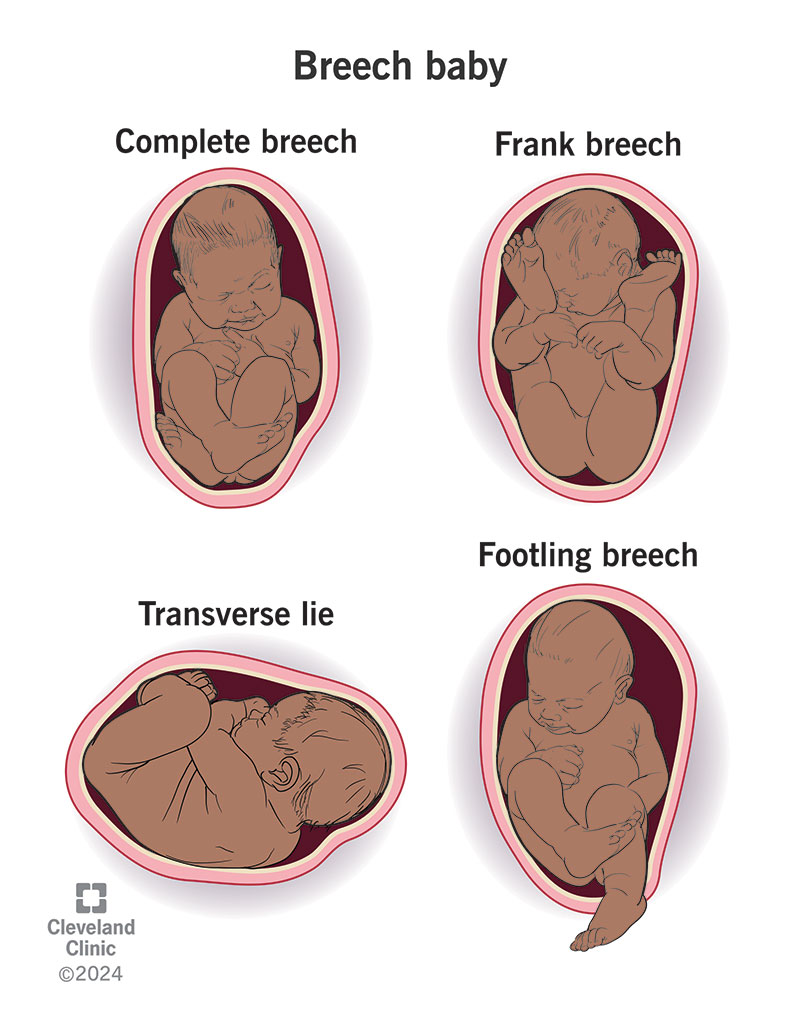
Breech babies can be in a few different positions:
- Frank breech: The baby'due south buttocks are aimed at the vaginal canal with its legs sticking direct upward in front of their body and the feet near their head.
- Consummate breech: The baby's buttocks are pointing downward and both the hips and the knees are flexed (folded under themselves).
- Trivial breech: One or both of the baby's feet signal downward and volition deliver earlier the rest of their torso.
- Transverse lie: This is a form of breech presentation where your babe is positioned horizontally across your uterus instead of vertically. This would make their shoulder enter the vagina start.
How does a breech baby affect pregnancy?
Your pregnancy is usually not afflicted. Most breech babies are born healthy, although at that place is a slightly elevated hazard for sure birth defects. Your baby's movements may feel a little different. You will feel your infant's kicks lower in your belly. Yous may experience a hard lump closer to your ribs. This is your baby's head.
If you lot planned a vaginal commitment, a breech baby could alter these plans. When your baby is breech, a vaginal delivery can exist complicated and dangerous. Your healthcare provider may feel comfortable attempting a vaginal breech delivery, but in about cases, they will recommend a Cesarean birth (C-section).
How does a breech babe bear upon delivery?
If your baby presents in a breech position after 36 weeks of pregnancy, your birthing program volition likely change. It's normally dangerous for a breech babe to be born vaginally due to risks of injury. In most cases, a planned C-section is the safest style to deliver your infant. Some healthcare providers may be comfortable with a vaginal breech birth. In some cases, turning your baby to a caput-downwards position while they are all the same inside your uterus is an option. Your baby is then born caput start.
Symptoms and Causes
How can y'all tell if your baby is breech?
You may exist able to tell if your infant is breech, especially if you have had past pregnancies where your baby was head-first. The places where you feel lumps and kicks might indicate that your baby is breech. Let your healthcare provider know where you feel movement. They will feel your abdomen or practice an ultrasound to confirm that your baby is breech.
What causes a babe to exist breech?
It's non ever known why a baby is breech. Some factors that may contribute to this position are:
- You are expecting multiples (twins or more). This makes it harder for each babe to get into the right position.
- There is also much or likewise trivial amniotic fluid.
- The uterus is non normal in shape or has abnormal growths such as fibroids. Most of the time, the uterus is shaped similar an upside-down pear. If it's shaped differently, in that location might not be enough room for a total-grown baby to movement into position.
- The placenta covers all or part of the neck (a condition called placenta previa).
- The babe is preterm. This means they are less than 37 weeks gestation and may non accept turned to a head-outset position.
- Your baby has a nascency defect that causes them to not turn caput-downward.
Diagnosis and Tests
How is a breech baby diagnosed?
Your healthcare provider may be able to tell which way your babe is facing by placing their hands at certain places on your abdomen. Past feeling where the baby'southward caput, dorsum and buttocks are, it's usually possible to observe out what part of the baby is positioned to come out of the vagina first. An ultrasound may exist used to confirm the babe's position.
When is a breech baby diagnosed?
Almost all babies are breech at some signal. As your pregnancy progresses, your baby will naturally move to a caput-downwardly position — probably between 32 and 36 weeks. Your healthcare provider will feel your belly and determine where your baby is positioned. This will happen during nigh of your appointments in the third trimester. Later on 37 weeks, a breech baby ordinarily does not turn on their ain. Your healthcare provider will hash out delivery options with you.
Management and Treatment
What are the options for treating a breech baby?
If your infant is breech at 37 weeks of pregnancy, your healthcare provider may:
- Attempt turning your baby in your uterus into the caput-first position.
- Programme a C-department birth.
- Plan a vaginal breech birth.
What are some complications of having a breech baby?
The complications of having a breech babe ordinarily do not occur until it's time to deliver. Some breech babies can be safely delivered through the vagina.
The risks of attempting a vaginal breech birth are:
- Injuries to your baby's legs or arms such equally dislocated or broken bones.
- Umbilical cord problems. The umbilical string tin can be flattened or twisted during delivery. This can crusade nerve or encephalon harm due to a lack of oxygen.
Volition my doctor endeavour to flip my baby if it'south breech?
If your baby is breech, your healthcare provider may consider turning your baby so that you tin have a vaginal delivery. In some cases, trying to turn your baby may not be safe or the risks outweigh the benefits.
Flipping your baby may not exist rubber if you have any of the following:
- Bleeding from your vagina.
- Placenta previa. This is when your placenta covers all or part of your cervix.
- A nonreactive nonstress test.
- An abnormally small baby.
- Low level of amniotic fluid.
- Depression or high fetal heart rate.
- Premature rupture of the membranes.
- Twins or multiples.
The virtually mutual method used to plough a breech baby is called external cephalic version (ECV). Information technology'due south performed past your healthcare provider around 37 weeks of pregnancy. This procedure is performed in the hospital just in case an emergency occurs. It involves placing easily on your belly and applying firm force per unit area to turn your baby to a head-down position while your baby is still in your uterus. It is about 65% effective and carries some risks.
What are the risks of turning my breech babe?
The risks of ECV include the post-obit:
- Premature labor.
- Premature rupture of the amniotic sac.
- Blood loss for either you or your baby.
- Emergency C-section.
- Your baby might plough back to the breech position.
Although the hazard of having these complications is small, some healthcare providers prefer not to try to flip a breech baby.
Will my breech baby flip on their own?
Most babies volition flip to a caput-down position before they attain full term (37 weeks). If your baby is however in a breech position at this time, your healthcare provider volition determine if you tin can deliver vaginally or if you will demand a C-section.
How can I flip my baby if it's breech?
Some women volition try at-home methods to flip their baby to a caput-first position. They may help, just in that location is no scientific evidence that they work.
- Bridge position: Lie on the flooring with your legs bent and your feet flat on the ground. Raise your hips and pelvis into a bridge position. Hold this position for 10 or xv minutes several times a day.
- Child's pose: Residuum in the child'south pose for x to fifteen minutes. It can assistance relax your pelvic muscles and uterus. You can also rock dorsum and forth on your easily and knees or make circles with your pelvis to promote activity.
- Music: Place headphones or a speaker at the lesser of your uterus to encourage your babe to plough.
- Temperature: Try placing something cold at the top of your stomach where your baby'southward head is. So, place something warm at the bottom of your breadbasket.
A chiropractic technique, called the Webster technique, can likewise help your uterus relax. Some providers even recommend acupuncture. Both of these techniques demand to exist done by a professional that your healthcare provider has recommended.
Prevention
How can I reduce my risk of having a breech baby?
In that location is nothing you can do to prevent your babe from existence in a breech position. If your infant is in a breech position, it'south not considering you did annihilation incorrect.
Outlook / Prognosis
Can you evangelize vaginally with a baby breech?
It's possible to deliver a breech baby vaginally. It tin be more dangerous for the baby and the take a chance of injury is much higher. If the umbilical string is compressed during nascence, the baby could exist deprived of oxygen and this could harm their brain and fretfulness. The string could also slip effectually the baby's neck or arms, causing injury. Healthcare providers have various levels of comfort with vaginal deliveries of breech babies. Talk to your provider about the risks and benefits of unlike types of nascence for a breech babe.
Living With
When should I see my healthcare provider?
Contact your healthcare provider if y'all experience any of the following symptoms during pregnancy:
- Severe cramping or contractions.
- Vaginal bleeding.
What questions should I ask my doctor?
Learning your babe is breech may give y'all concerns about your delivery. It'due south completely natural to accept questions. Some questions to ask your md tin can include:
- How can I tell if my baby is breech?
- Is my baby OK?
- What are the benefits and risks of turning my infant?
- What are my options for commitment if my baby remains in the breech position?
- What are the health risks to my baby and me if they are born breech?
Frequently Asked Questions
Do nascence defects cause breech position?
Nativity defects are slightly more common in breech babies. It might be the reason that the babe didn't move to the head-downwardly position. Most babies who are breech at commitment are born without any health complications.
Will I need a C-department if my baby is breech?
Most of the time, a C-section is the safest style to deliver a breech baby. Your risks of developing complications are much higher if you effort to deliver a breech baby through the vagina. Even so, some healthcare providers may feel comfortable performing a vaginal breech birth.
How does labor start if your baby is breech?
Having a breech baby doesn't change some of the first signs of labor similar contractions or rupturing of your membranes. In near cases, your healthcare provider volition recommend a planned C-department. If your delivery is planned, yous may not accept any labor symptoms.
If yous are in labor and become to the hospital for delivery, your provider will confirm your baby'south position a final time. Your provider could effort a vaginal commitment, just it'south more likely they will proceed with a C-department to be safe.
A note from Cleveland Clinic
Having a breech infant can be unexpected and change the vision yous had for childbirth. Talk to your healthcare provider about what to expect during a breech delivery. They can help you empathize the risks and benefits of a breech nascence and so that you and your baby are kept safe.
Source: https://my.clevelandclinic.org/health/diseases/21848-breech-baby
0 Response to "What Is Involved in Turning a Breech Baby"
Post a Comment