Chinese Art and Archaeology Neolithic to Han Dynasty Transalate
Silk is a cloth first produced in Neolithic China from the filaments of the cocoon of the silk worm. It became a staple source of income for minor farmers and, every bit weaving techniques improved, the reputation of Chinese silk spread so that it became highly desired across the empires of the ancient world. As Cathay'southward most important export for much of its history, the cloth gave its name to the great trading network the Silk Road, which continued East Asia to Europe, India, and Africa. Not only used to make fine apparel, silk was used for fans, wall hangings, banners, and every bit a popular culling to newspaper for writers and artists.
Origins & Tillage
Silk is produced by silk worms (Bombyx mori) to form the cocoon within which the larvae develop. A single specimen is capable of producing a 0.025 mm thick thread over 900 metres (three,000 ft) long. Several such filaments are then twisted together to make a thread thick enough to be used to weave textile. Fabrics were created using looms, and treadle-operated versions appear in, for example, the murals in tombs of the Han dynasty (206 BCE - 220 CE). The silk could exist dyed and painted using such minerals and natural materials as cinnabar, red ochre, powdered silvery, powdered mollusk shells, and indigo and other inks extracted from vegetable matter.
The earliest known examples of woven silk appointment to c. 2700 BCE & come from the site of Qianshanyang in China.
Sericulture - that is the cultivation of mulberry leaves, the disposed of silkworms, the gathering of threads from their cocoons and the weaving of silk - first appears in the archaeological tape of ancient China c. 3600 BCE. Excavations at Hemudu in Zhejiang province have revealed Neolithic tools for weaving and silk gauze. The earliest known examples of woven silk date to c. 2700 BCE and come up from the site of Qianshanyang, also in Zhejiang. Recent archaeological testify suggests that the Indus Valley civilization in the n of the Indian subcontinent was also making silk contemporary with the Neolithic Chinese. They used the Antheraea moth to produce silk threads for weaving.
However, silk production on a large scale and involving more sophisticated weaving techniques would but appear from the Chinese Shang and Zhou dynasties in the 2nd millennium BCE. Silk then became ane of the nigh important manufactured and traded appurtenances in ancient China, and finds of Shang dynasty (c. 1600 - 1046 BCE) silk in an Egyptian tomb are testimony to its esteemed value and employ in early on international trade.
Development
During the Han dynasty, the quality of silk improved even further, becoming finer, stronger, and oft with multicoloured embroidered patterns and designs of human and animal figures. Chinese characters are also woven into the fabric of many surviving examples. The weave of some Han menstruation pieces, with 220 warp threads per centimetre, is extremely fine. The cultivation of the silk worms themselves besides became more sophisticated from the 1st century CE with techniques used to speed up or slow their growth by adjusting the temperature of their environment. Dissimilar breeds were used, and these were crossed to create silk worms capable of producing threads with different qualities useful to the weavers.
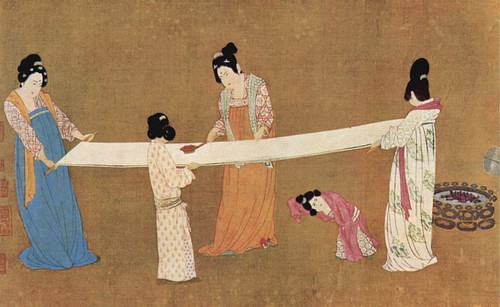
Women Checking Silk, Vocal China.
Weavers were usually women, and it was also their responsibility to make sure the silk worms were well fed on their favourite diet of chopped mulberry leaves and that they were sufficiently warm enough to spin thread for their cocoons. The industry became such a vital source of income for families that country dedicated to the cultivation of mulberry bushes was even made exempt from reforms which otherwise took away agronomical land from peasant buying and mulberry plots became the simply land that information technology was possible for farmers to merits hereditary ownership of. Mencius, the Confucian philosopher, advocated the smallest of land holdings always set aside a plot to establish mulberry. As demand grew, so the land and those with enough capital to do so set up up big workshops where both men and women worked. Great aristocratic houses had their own private silk production squad with several hundred workers employed in producing silk for the manor's needs and for resale. Silk production even became the subject of poems and songs such every bit this example from the Master Xun philosophical text of the Warring States menstruum:
How naked its external grade,
However it continually transforms like a spirit.
Its achievement covers the world,
For it has created ornament for a myriad generations.
Ritual ceremonies and musical performances are completed through it;
Noble and apprehensive are distinguished with information technology;
Young and old rely on it;
For with it alone can one survive.
(in Lewis, 114-115)
Eventually, the Chinese could no longer keep the lucrative secret of silk product to themselves and information technology began to be manufactured in Korea and Nihon where information technology would become a state-controlled industry. Other states and cultures and so acquired the skills of sericulture such as Republic of india around 300 CE, and from there it spread to Byzantium, Arabia, the Levant, and Italian republic.
Trade: the Silk Route
The fame of Chinese manufactured silk spread beyond the famous trade route which took its proper name - the Silk Road - such was the article's importance to the Chinese economy. The Silk Road or Sichou Zhi Lu was really an entire network of overland camel caravan routes connecting China to the Middle Eastward and hence is now often referred to as the Silk Routes by historians. Silk - in the grade of the thread, woven cloth, and finished products - was thus exported via middlemen (no single trader ever travelled the length of the routes) non just to neighbouring states such every bit the Korean kingdoms and Japan only also to the great empires of India, Persia, Arab republic of egypt, Greece, and Rome. In the case of the latter, it is said that the eventual financial collapse of the state was in part due to the constant drain of silverish to the east where it went to buy the silk that the Romans could not live without. The Romans even chosen the Chinese Seres, after the word for silk in that linguistic communication.
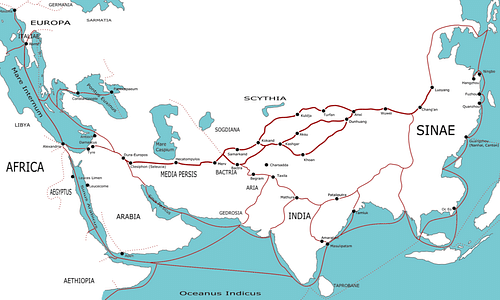
The Silk Road
In add-on to land routes and passage across the Inland Ocean to Nippon, from the 11th century CE Chinese junks sailed and traded across the Indian Body of water and silk thus remained the number one export product of Mainland china for centuries; information technology would simply exist rivalled by porcelain and tea from the 15th century CE. By the 20th century CE, it would be Japan that would replace China as the world's largest silk producer.
Uses
In Mainland china, and after elsewhere, silk was used to make habiliment (especially long robes, gowns, and jackets), hand fans, effects, wall hangings, screens, decorative scenes for and from famous books and poems, military banners, funeral banners, Buddhist mandalas, and for the purposes of writing instead of bamboo or newspaper. Brightly coloured and exquisitely embroidered silk robes became a status symbol and helped distinguish officials and courtiers from the cotton wool- or patently-silk-wearing lower classes. In other cultures, such as Korea, there were even laws forbidding the wearing of silk by persons below a certain social rank. Embroidered silk became so varied and refined that a whole connoisseurship developed around the material, similar to that surrounding the fine porcelain of Chinese potters. Taoist priests were another group who were distinguished by their silk robes, often embroidered with ceremonial scenes.
As a valuable commodity bolts of silk were often used as a form of currency, especially in the payment of tribute such equally by the Northern Song (960-1127 CE) and the Southern Song (1127-1276 CE) to the Liao and the Jin emperors, respectively. Silk was also an esteemed gift. Given to tributary states in appreciation of their loyalty, it was an impressive symbol of the Chinese emperor's great wealth and largesse. For example, in 25 BCE alone, the Han gave as gifts an incredible 20,000 rolls of silk cloth. Traders used it is a payment, people paid their taxation with it, and even armies were sometimes paid in silk.
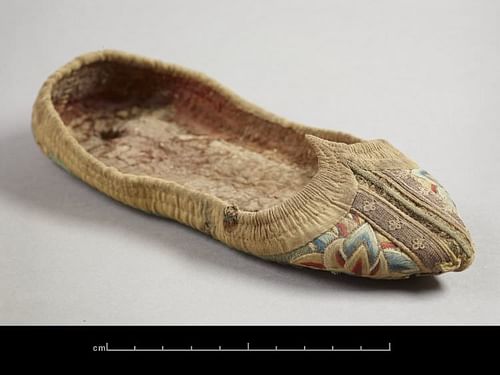
Silk & Textile Shoe from China
In art, silk became a pop surface on which to paint landscape scenes and portraits. Tang dynasty (618-907 CE) artists were particularly famed for their skills in dyeing, press and painting on silk, with many examples of their work surviving in Nihon where they were sent as gifts. Silk books were made which had copies of famous paintings and so became reference albums for art connoisseurs.
Cultural Repercussions
The merchandise of silk and other commodities forth the Silk Road also brought with it ideas and cultural practices in both directions; language and writing were specially important elements transmitted along the routes past traders, diplomats, monks, and travellers. Buddhism came to China from India and was so passed on to Korea and Nihon. Explorers such as Marco Polo used the route, equally did Christian missionaries from the west to enter Cathay for the first time. New foodstuffs were introduced into China and and so cultivated there such equally walnuts, pomegranates, sesame, and coriander. Silk, symbol of Prc for so long, had opened the doors to new lands and new ideas, and finally connected the great empires of the ancient earth.
This article has been reviewed for accuracy, reliability and adherence to bookish standards prior to publication.
Source: https://www.worldhistory.org/Silk/
0 Response to "Chinese Art and Archaeology Neolithic to Han Dynasty Transalate"
Post a Comment